

In the world of cross-border e-Commerce, the Print on Demand (POD) model has been praised as one of the easiest ways to start a business. It requires low initial investment, zero inventory management, and eliminates logistics headaches. However, in today’s saturated market, the ultimate question every entrepreneur must face is: Is POD still a viable path to wealth, or is it a time-consuming trap with razor-thin margins?
1. The Profit Margin Trap and the Hard Truth Gurus Don’t Tell You
Popular POD providers like Printful or Printify offer incredible convenience, but that convenience comes at a steep price.
-
Extremely Low Profit Margins: When you add up the base cost of a t-shirt and international shipping from a POD provider, your total cost can easily reach $20–$22 per item. To make a modest profit of $5–$10, you would have to price your shirt at $26–$31—a price point that new customers are rarely willing to pay for an unestablished brand.
-
No Budget for Paid Ads: With profit margins squeezed down to 10–20%, you are left with zero ad budget for paid traffic channels like Facebook, TikTok, or Google Ads. Relying solely on organic searches on marketplaces like Amazon or Etsy becomes an uphill, exhausting battle.
-
Lack of Quality Control and Branding Options: You cannot touch the fabric before it ships, inspect the print quality, or fully customize the unboxing experience with branded packaging.
2. The Classic Alternative: In-House Production Lowers Costs, but Adds Major Operational Overhead
Industry experts often suggest solving the margin problem by purchasing your own equipment (such as DTF or White Toner printers). Printing in-house can drastically slash production costs from $20 down to $2.50–$4.00 per shirt, increasing your profit potential by 6 to 8 times.
However, in-house production carries a dark side that can be daunting for small business owners:
-
Financial Risk and Sunk Costs: High upfront costs for printers, ink, films, and blank garments represent significant fixed overhead. For instance, DTF printers require daily operation; letting them sit idle leads to clogged printheads and costly repairs.
-
Operational Bottlenecks: Your valuable time becomes consumed by printing, heat-pressing, packing, shipping, and handling defective returns—time that should be spent on design and brand strategy.
-
Geographic Barriers (The Major Hurdle for Sellers Outside the US): If your target audience is in the United States or Europe, running an in-house production line out of a country like Thailand is practically impossible. High international express shipping rates, long transit times, and complex import duties will quickly undermine your business model.
3. The Red Ocean Market and the Limits of “Design Alone”
Unable to set up overseas production lines, many creators double down on “standout designs” on major platforms like Amazon or Etsy. But in reality, great design alone cannot overcome every structural limitation.
Today’s e-Commerce landscape is flooded with design-spying tools, copycats, automated design generation bots, and hundreds of thousands of competitors using the exact same AI tools and POD fulfillment networks to upload tens of thousands of new listings daily. Hoping that customers will randomly discover your t-shirt through a basic keyword search is like searching for a needle in the ocean.
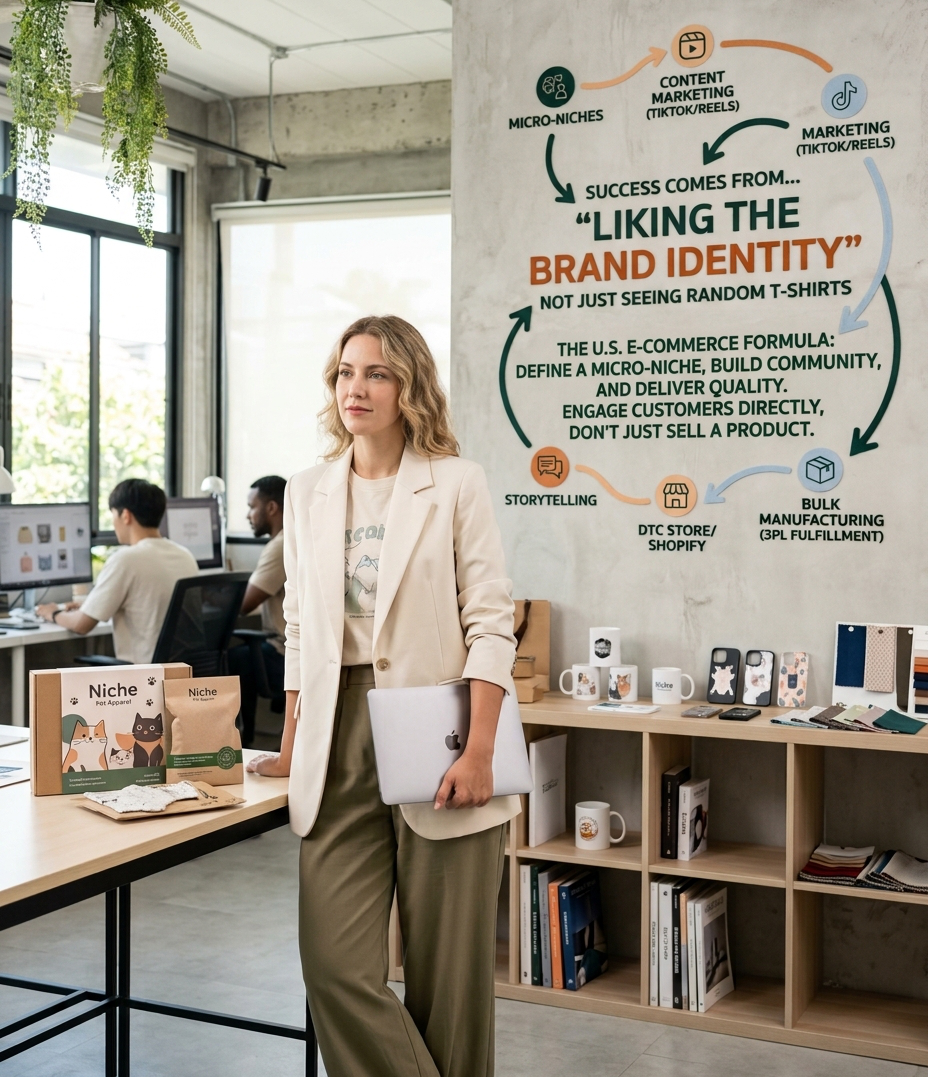
4. The Practical Way Out: Transition from Selling “Shirt Patterns” to Selling “Brand Identity”
The only sustainable path forward for sellers operating outside the US is to ensure that “customers buy because they love the brand’s identity, not because they happened to scroll past a random t-shirt in search results.” In practice, this execution involves:
-
Defining a Deep Micro-Niche: Move away from broad, generic designs. Instead, target specific subcultures with a strong sense of identity—such as “sarcastic orange cat owners” or “minimalist camping enthusiasts.” Niche audiences are far more willing to pay a premium for products that truly represent them.
-
Becoming a Content Creator (Content Marketing): Stop posting flat-lay mockups on plain white backgrounds. Instead, leverage short-form video platforms like TikTok and Instagram Reels to show behind-the-scenes design processes, share brand storytelling, or create relatable inside jokes that resonate with your specific niche.
-
Building Your Own Direct-to-Consumer (DTC) Channel: Drive social media traffic directly to your own webstore (e.g., Shopify or Etsy) rather than relying blindly on marketplace search engines. Capture email lists using digital freebies to build a loyal fanbase for future product launches.
The Low-Risk Growth Strategy
-
Launch Phase: Use POD as a risk-free shield. Launch unique designs supported by content marketing and brand storytelling. Even if your profit margin per unit is small, you bear zero inventory risk and zero logistics headaches.
-
Scaling Phase: Once a specific design becomes a proven best-seller, transition from on-demand printing to bulk manufacturing. Ship those top performers directly to a 3rd-Party Fulfillment Center (3PL) located in your destination market. This approach significantly reduces production costs, delivers fast local shipping, and allows you to capture maximum profit without taking on the burden of owning printing machinery.