

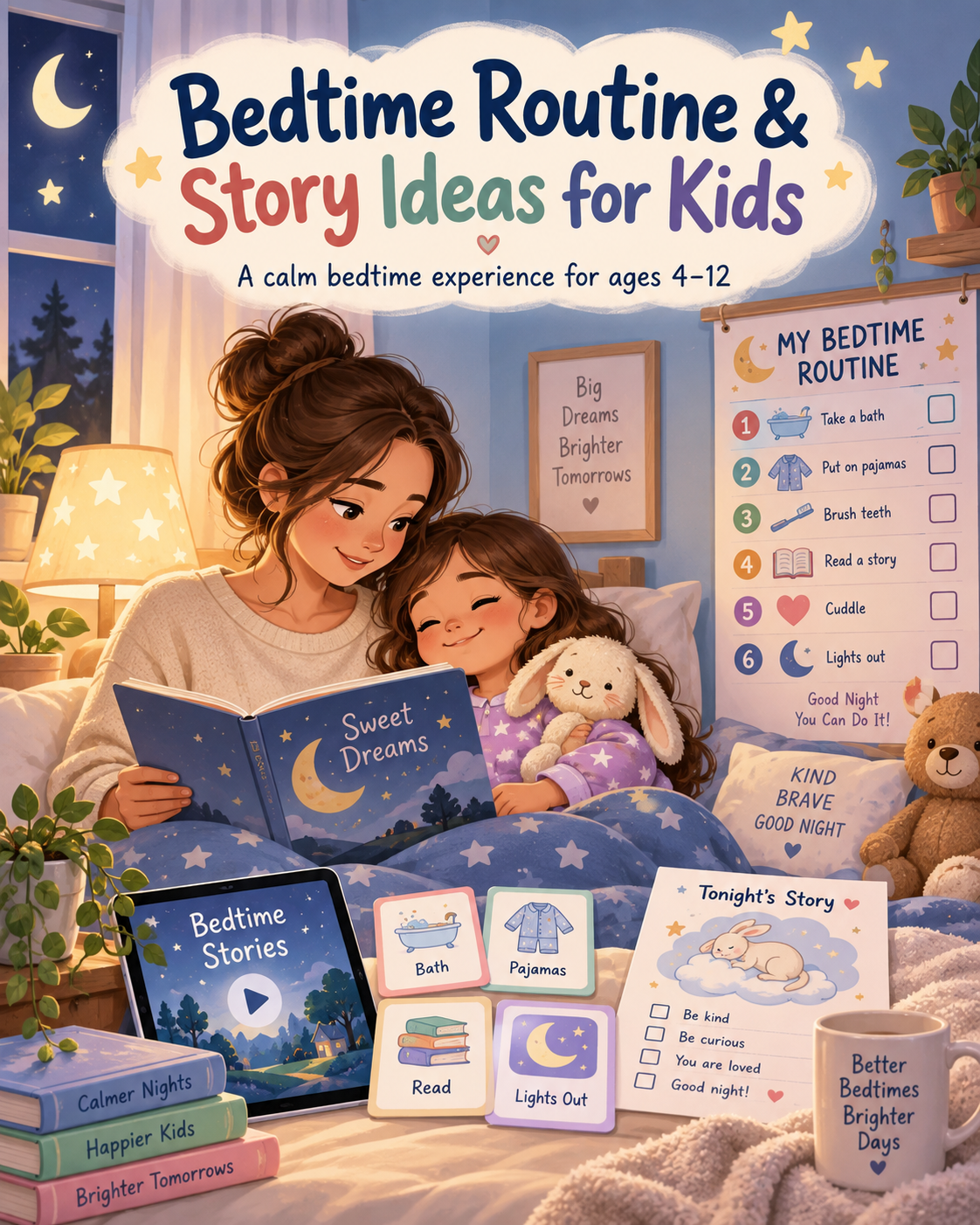
Digital products for children’s bedrooms can go far beyond wall art and decorative printables. They can also support bedtime routines, help create a calmer atmosphere, and make the evening process easier for parents.
One particularly promising direction is combining bedtime routines, bedtime stories, and audio stories into a more complete product experience.
Current market examples show that this type of product already exists in several forms, including bedtime audio downloads, printable routine charts, visual schedules, and personalized audio stories. This means the concept is not purely theoretical. There are already real sellers, real competitors, and real buyers in the market. However, it would be inaccurate to say that the market is automatically “growing rapidly” without stronger evidence. A more realistic conclusion is that the market is established, active, and competitive, especially at the lower-priced end.
Bedtime Routine Products Have Demand, but Basic Printables Are Highly Competitive
A search for terms such as “bedtime routine kids” reveals three common content types: educational infographics, printable checklists or charts, and problem-solving content built around ideas such as “bedtime doesn’t have to be a battle” or “no screens before bed.”
This is important because it shows that parents are not only looking for something decorative. They are often looking for a practical solution to make bedtime calmer and easier.
On marketplaces such as Etsy, existing products include low-cost bedtime charts, editable routines, visual schedules, and combined morning-and-bedtime packages. Some sellers add more functionality through editable task cards, larger sets of visual cards, blank or customizable versions, reusable designs, and flip-chart formats.
The challenge is that a simple one-page bedtime chart or checklist is already a crowded product category. Many basic printable products are sold at low prices, which makes it difficult to compete on price alone. If a product contains only one or two printable pages, it can quickly become trapped in the low-price segment of the market.
A Better Opportunity: Sell a Bedtime Experience
Instead of selling only a bedtime chart or an MP3 file, a stronger approach is to create a Bedtime Experience Product.
The key is to avoid selling an audio story as a standalone MP3. If customers see only an audio file, they may immediately compare it with free alternatives on YouTube, Spotify, podcasts, or apps.
A more differentiated product combines the audio with practical printables, routines, and activities, creating a Printable + Audio Bedtime Experience.
This approach fits especially well with a children’s bedroom brand such as North & Nook because the product can connect directly with existing bedroom themes.
For example:
Space Bedroom Collection
Space wall art
Space printable decor
“Goodnight, Little Astronaut” bedtime story
Dinosaur Bedroom Collection
Dinosaur wall art
Dinosaur printables
“The Sleepy Dinosaur’s Last Adventure”
Ocean Bedroom Collection
Ocean room decor
Ocean printables
“The Little Whale Who Followed the Moon”
The bigger idea is simple:
One theme = bedroom + printable + story + bedtime routine
This creates a much more cohesive brand experience than selling unrelated MP3 files or random printables.
Three Product Models
There are three main ways to develop this product idea. Each model has a different level of complexity, production time, pricing potential, and brand value.
Model 1: Routine + Bedtime Story
The first model combines a printable bedtime routine system with a short story in PDF format.
A typical product could include:
- Bedtime Routine Chart
- Visual Routine Cards
- Reward Tracker
- Bedtime Story PDF
- Parent Guide
- One or two coloring pages
An example product could be:
Space Bedtime Routine & Story Pack for Kids Ages 4–7
A reasonable test price could be around $5.99–$7.99.
The biggest advantage of this model is that it is relatively quick and inexpensive to create. Once the first master template is finished, the same structure can be reused for multiple themes such as Space, Dinosaur, Ocean, Unicorn, or Woodland.
The illustrations, story, and design elements can change while the overall product structure remains the same. This makes it easy to build several products from one production system.
The main weakness is differentiation. Customers may ask why they should buy a $6–$8 package when they can purchase a basic bedtime chart for a few dollars and use books they already own.
For that reason, the story needs to feel like an essential part of the bedtime experience rather than a simple bonus PDF.
Model 2: Routine + Audio Story
The second model adds an audio component, which makes the product more distinctive.
A package could include:
- Bedtime Routine Chart
- Routine Cards
- Reward Tracker
- 7–10 minute MP3 story
- Story transcript
- Parent Guide
- QR Code or Listening Card
The routine could end with a “Story Time” step, after which the parent plays the audio story while the child is already in bed.
This turns the product into something more than a printable. It becomes a screen-free bedtime routine system with an audio experience.
A reasonable test price might be around $7.99–$10.99.
However, this model requires more production work. The creator needs to write the script, record or generate the voice, edit the audio, check sound levels, export the MP3, manage delivery, and test the listening experience on mobile devices.
The advantage is that the product has a clearer unique selling proposition. It is harder to compare directly with a basic printable chart because the customer is buying a complete routine plus a listening experience.
Model 3: Theme-Based Bedtime Kit
The third model combines everything into one themed package and has the strongest long-term branding potential.
For example:
Space Bedtime Adventure Kit
The package could include:
- My Bedtime Mission Chart
- 18 Routine Cards
- Weekly Reward Chart
- Calm Breathing Cards
- Printable Door Hanger
- 2–3 Space Wall Art Prints
- Coloring Pages
- Bedtime Story PDF
- Bedtime Story MP3
- Parent Guide
- “Tonight’s Mission” Card
- Editable Child Name Version
At this stage, the product is no longer just a bedtime chart. It becomes a complete themed bedtime experience for a child’s bedroom.
This model fits a brand such as North & Nook especially well because physical products, digital products, content, and Pinterest traffic can all connect around the same theme.
For example, one Space Collection could include:
Physical Products
- Space blanket
- Space pillow
- Space wall canvas
Digital Products
- Space printable wall art
- Space bedtime kit
Blog Content
- Space bedroom ideas
- Bedtime routine tips
Pinterest Content
- Space bedroom inspiration
- Screen-free bedtime ideas
- Space bedtime routine
All of these pieces support the same theme and create a stronger brand ecosystem.
The disadvantage is the amount of work required. If the product includes 20–30 pages, audio, editable files, printable decor, and multiple bonuses, it can take significant time to build. If there is little market interest, much more time is lost compared with testing a smaller product first.
Which Model Is Best?
From a market-testing perspective, Routine + Bedtime Story is the safest starting point because it is fast and inexpensive to produce.
Routine + Audio Story offers better differentiation and stronger perceived value.
Theme-Based Bedtime Kit has the greatest long-term brand potential, but it also requires the most time and effort.
A simple comparison looks like this:
| Model | Difficulty | Suggested Price | Differentiation | Risk |
|---|---|---|---|---|
| Routine + Story | Low | $4.99–$7.99 | Medium | Lowest |
| Routine + Audio Story | Medium | $6.99–$10.99 | Good | Low–Medium |
| Theme-Based Bedtime Kit | High | $9.99–$14.99+ | Highest | Higher |
The first model is the easiest to test, while the third model offers the strongest long-term opportunities for branding, bundling, and upselling.
The Best Strategy: Build a Product Ladder
Rather than choosing one model forever, the strongest strategy is to build a product ladder.
Start with:
Phase 1 — Routine + Story
Around $5.99
If the product receives interest:
Phase 2 — Routine + Story + Audio
Around $8.99
Then expand it into:
Phase 3 — Complete Bedtime Kit
Around $12.99
Once several themes exist, combine them into a larger bundle:
Space + Dinosaur + Ocean + Woodland Bedtime Adventure Bundle
Around $29–$39.
The benefit of this approach is that the same core assets can be reused across multiple products.
For example:
Product A — $5.99
Space Bedtime Routine & Story
Product B — $8.99
Space Bedtime Routine & Audio Story
Product C — $12.99
Complete Space Bedtime Adventure Kit
The customer can choose the level they want, while the creator does not need to rebuild the product from scratch each time.
A Practical Starting Point
The most practical first product would be:
Space Bedtime Routine & Story Kit
The first version could include:
- Bedtime chart
- Routine cards
- Reward page
- Short bedtime story
- Parent guide
- Two bonus wall art prints
Audio does not need to be included immediately.
This smaller product can test whether customers are interested in the theme, the routine concept, and the story component before investing more time in audio production.
If the product performs well, the next step would be to add audio and eventually expand it into a full Space Bedtime Adventure Kit.
The same system could then be duplicated for Dinosaur, Ocean, and other themes.
A low-risk development path would therefore be:
Space Routine + Story → Test the Market → Add Audio → Expand into a Complete Kit → Replicate for Dinosaur and Ocean
This approach is far safer than building a large, complex bedtime kit before knowing whether customers are interested.
Conclusion
The strongest opportunity in this market is not simply selling another bedtime chart.
Basic bedtime printables are already widely available and often compete heavily on price. A more promising direction is to turn bedtime products into a themed experience that combines routines, stories, audio, rewards, and bedroom decor.
Routine + Bedtime Story offers the easiest entry point.
Routine + Audio Story provides stronger differentiation.
Theme-Based Bedtime Kits offer the greatest long-term branding potential.
By developing the products gradually, one theme can grow from a simple printable into an audio product, a complete bedtime kit, and eventually a larger multi-theme bundle.
This creates more value from the same creative assets while also connecting digital products, physical products, blog content, and Pinterest marketing within one coherent children’s bedroom brand.