

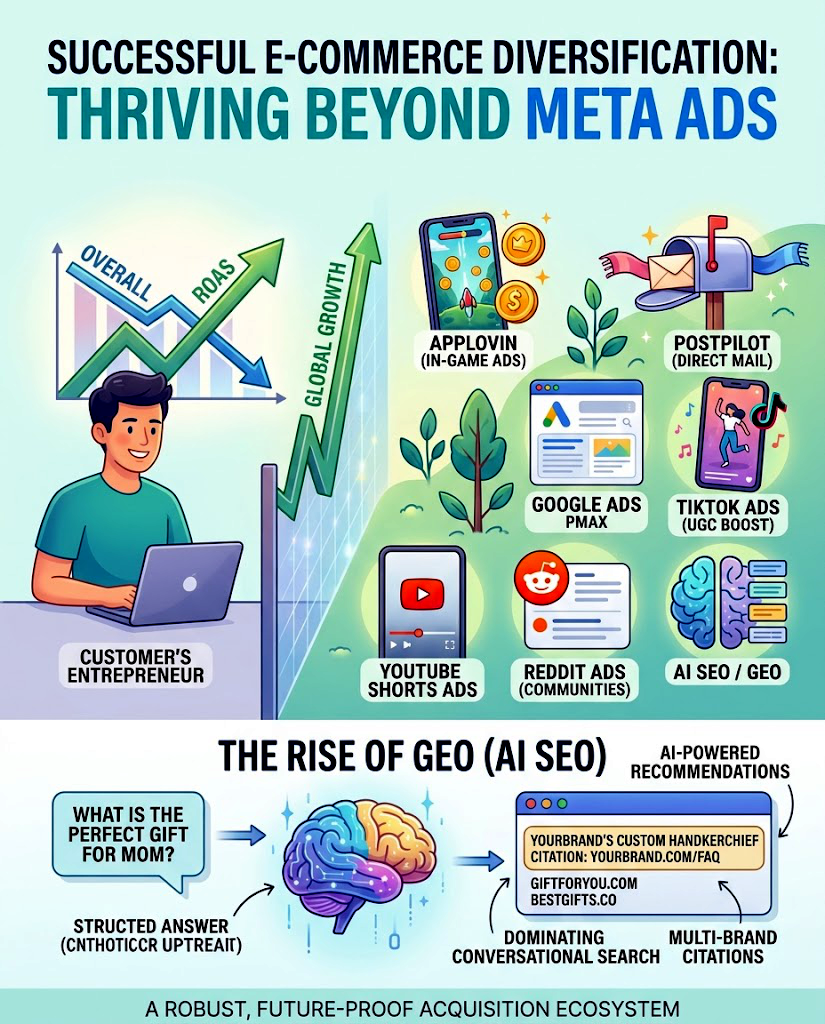
As Facebook and Instagram ad costs (Meta Ads) continue to rise while returns on ad spend (ROAS) decline, e-commerce brand owners must diversify. Staying competitive requires exploring high-converting, lower-cost channels and optimizing for the future of search: Generative Engine Optimization (GEO).
Part 1: 7 Alternative Marketing Channels to Meta Ads
Teacher Guide Note: > Avoid completely shutting off Meta Ads overnight. Instead, reallocate your ad budget across 3–4 of these platforms to make your acquisition strategy resilient to algorithm shifts.
-
AppLovin (In-Game Mobile Ads): * Key Advantage: Low CPMs targeting mobile gamers (skewing heavily toward women aged 30–40 playing casual games like Candy Crush). Overlap with Meta’s audience is often under 5%.
-
Best For: Brands with large product catalogs and sufficient budget for algorithmic learning.
-
-
PostPilot / Direct Mail (Physical Mailbox): * Key Advantage: High open and retention rates. Uses your existing customer file to send physical postcards or build targeted lookalike audiences.
-
Best For: Win-back campaigns (customer retention) and high Average Order Value (AOV) products.
-
-
Google Ads Performance Max (PMax): * Key Advantage: Captures high-intent buyers across Search, Shopping, Display, and YouTube. PMax product feeds automatically qualify for placement in Google’s AI Search Overviews.
-
Best For: Established products and brands with existing search volume.
-
-
TikTok Ads (Organic + Paid Amplification): * Key Advantage: Lowest CPMs among major social platforms. Works best using an “Organic + Paid” strategy: post User-Generated Content (UGC) organically, identify high performers, and boost them with paid spend.
-
Best For: Visual products targeting audiences under 60.
-
-
YouTube Shorts Ads: * Key Advantage: Massive global reach (200B+ daily views) with significantly lower e-commerce seller competition compared to TikTok, resulting in cheaper ad inventory.
-
Best For: Brands with existing short-form vertical video assets.
-
-
Reddit Ads: * Key Advantage: Targets highly passionate niche communities (e.g., specialty coffee, board games, skincare). Ads succeed when they offer genuine value or community education rather than hard sales pitches.
-
Best For: Niche products solving specific problems for hobbyists or dedicated communities.
-
-
AI SEO / GEO (Generative Engine Optimization): * Key Advantage: An organic acquisition strategy focused on getting your products cited and recommended directly inside generative AI responses (ChatGPT, Perplexity, Gemini).
Part 2: Deep Dive into Generative Engine Optimization (GEO)
What is GEO? Generative Engine Optimization (GEO) is the evolution of traditional SEO. Instead of optimizing content to rank in the “Top 10 Blue Links” on Google, GEO optimizes content so that LLM-based engines (ChatGPT, Perplexity, Gemini, and Google AI Overviews) extract your content and cite your brand as the recommended answer.
Traditional SEO vs. GEO Comparison
| Metric | Traditional SEO | Generative Engine Optimization (GEO) |
| Primary Goal | Rank #1–#10 on Google Search | Get cited/recommended in AI conversational outputs |
| Search Intent | Short keywords (e.g., “custom handkerchiefs”) | Long conversational prompts/questions |
| Optimization Focus | Backlinks, Keyword Density, Site Structure | Direct answers, Structured Schema, Reddit/Community discussions |
Part 3: Step-by-Step GEO Implementation Guide
Teacher Guide Checklist:
Step 1: Map Customer Avatars & Real Questions
Identify exact questions your customers ask across every stage of their journey (e.g., care instructions, shipping timelines, return policies, customization options).
Step 2: Adopt an “Answer-First” Format
Structure website content to deliver direct, clear answers in the very first sentence. This makes it effortless for AI bots to parse and cite your text.
Step 3: Implement FAQPage Schema (JSON-LD)
Inject structured metadata into your product page
<head> code to give search engines and AI models explicit data context.Production-Ready JSON-LD Example:
HTML
<script type="application/ld+json">
{
  "@context": "https://schema.org",
  "@type": "FAQPage",
  "mainEntity": [
    {
      "@type": "Question",
      "name": "How long does shipping take for custom embroidered items?",
      "acceptedAnswer": {
        "@type": "Answer",
        "text": "Custom orders require 2-3 business days for production and arrive within 1-2 business days after shipment."
      }
    },
    {
      "@type": "Question",
      "name": "What is the return policy for personalized products?",
      "acceptedAnswer": {
        "@type": "Answer",
        "text": "If there is a manufacturing defect or spelling error on our part, we offer a free replacement within 7 business days."
      }
    }
  ]
}
</script>
Step 4: Build Off-Site GEO Authority
Maintain an active, organic presence on platforms frequently scraped by AI engines, particularly Reddit and YouTube. AI engines heavily cite organic community discussions when recommending products.
Key Takeaway
Over-reliance on a single advertising channel represents a core risk for e-commerce businesses. Diversifying ad spend across emerging platforms while optimizing your web store for AI SEO (GEO) ensures sustainable, long-term growth in the evolving digital landscape.